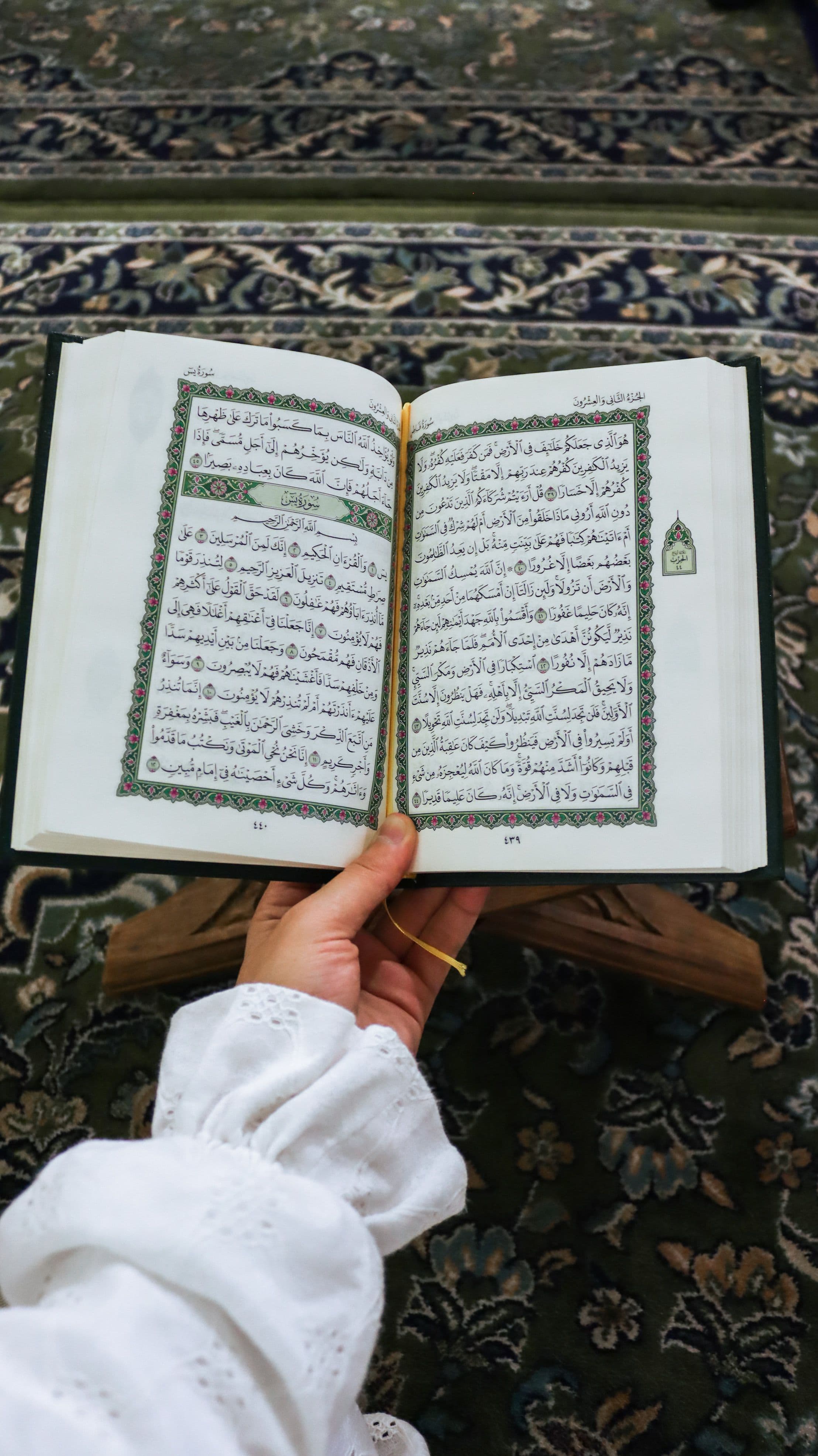
Every Hifz student hits a period where the new portions aren't sticking, the old ones are slipping, and the whole project feels heavier than it did at the start. I've been through this myself, every Hafiza has, and I watch my students go through it too. The students who come out the other side and complete their Hifz aren't the ones who never struggle. They're the ones who have specific habits for the difficult stretches.
This article gives you two things: the Duas that are specifically tied to memorisation and knowledge-seeking, and the practical motivation habits I've seen work consistently across my students.
Duas specifically for memorisation and seeking knowledge
Before I list these, a note on how to use them. A Dua said as a formula, words said quickly before opening the Mushaf, is different from a Dua said with presence and intention. Both are better than nothing. But if you have a moment before your memorisation session to sit with these words and mean them, the effect on your mental state going into the session is noticeably different.
Dua before studying or memorising:
Rabbi zidni ilma, "My Lord, increase me in knowledge." (From Surah Ta-Ha, 20:114)
This is the shortest and perhaps most used Dua for learning. Memorise it if you haven't already. Saying it before opening the Mushaf takes three seconds and sets a clear intention.
Dua for help with memory:
Allahumma inni as'aluka 'ilman nafi'an wa rizqan tayyiban wa 'amalan mutaqabbala, "O Allah, I ask You for beneficial knowledge, good provision, and accepted deeds."
This is a well-known morning Dua that appears in hadith collections. For Hifz students, the phrase "beneficial knowledge" is worth dwelling on, you are asking specifically for the kind of knowledge that serves you, which Quran memorisation directly is.
Before beginning your Sabaq (new memorisation):
Many of my students recite Bismillahir rahmanir rahim deliberately, not as a formula but as a genuine invocation of Allah's name before the new work begins. Scholars generally hold that beginning any significant act in the name of Allah is recommended, and beginning your Sabaq this way marks the mental transition from ordinary activity to something different.
The connection between Dua and focus
When students ask me why Dua matters for Hifz, rather than just technique and discipline, my answer is practical as well as spiritual. The act of making Dua before memorisation requires you to stop, settle, and direct your attention before starting. That transition alone improves focus. A student who rushes from WhatsApp to her Mushaf without a moment of settling will take longer to reach real mental engagement with the verses than a student who takes thirty seconds to make Dua and consciously arrive.
The spiritual dimension, that Allah actually assists those who ask, I hold firmly. But I mention the practical dimension too because even sceptics can observe the focus-setting effect.
Motivation habits that actually work
Track the accumulation, not the gap
The students who struggle most with motivation are usually tracking how far they have to go rather than how far they've come. "I've only done 4 Juz. There are 26 left." This framing is demoralising and mathematically accurate, which makes it worse.
A simple shift: track what you have. A list of every Surah you've completed, with a mark next to each. A tally of the verses memorised, added up. This is concrete. You can read it on a hard day and see that something real has been built.
The students in my online Hifz program who make the most consistent progress are almost always the ones who have some form of visible accumulation tracking, a notebook, a chart, a simple spreadsheet.
Use the revision to renew the motivation
On the days when new memorisation feels impossible, when the words won't fix in memory and you've been on the same half-page for twenty minutes, shift to Manzil revision instead. Go back to something you've already completed. Recite it fluently. Your brain recognises the pattern, the sounds come easily, and you finish the session having done something well.
This is not avoiding the difficult work. It is using the more accomplished portions to remind yourself what is possible. You had that same difficulty with Juz Amma, and now it flows. The current struggle is temporary.
Short sessions in the hard stretches
When motivation is low, the single worst response is to extend the session length out of guilt. A student who is struggling and forces herself to sit for ninety minutes produces poor-quality memorisation while burning through the motivation she needs for tomorrow.
Fifteen focused minutes of Sabaq on a hard day is worth more than ninety unfocused ones. Alhamdulillah for the fifteen. Come back tomorrow.
For the full system of managing new memorisation, daily revision, and long-term retention together, the article on how to avoid forgetting the Quran after memorising it covers the structure in detail. The system matters as much as the motivation.
Find a Hifz companion
One of the structural advantages of in-person Hifz programs is accountability, another student asking "how's your Sabaq today?" creates mild social accountability that keeps the practice happening. Online, this is harder to replicate but not impossible.
Some of my students have a family member, a sibling, or a friend in their household who checks in each evening: "Did you do your Sabaq?" Not someone who monitors quality or gives feedback, just someone who asks. The knowledge that this question is coming is enough to keep the daily session happening on days when nothing else would.
Weekly review of your starting point
Once a month, or whenever the journey feels endless, go back and recite the very first Surah you memorised. Hear how solid it is. Remember what it felt like to memorise it. The person who recites that Surah confidently now is the same person who is struggling with the new portion. That version of you is not far away. You built it once; you will build the next section the same way.
On the difficult surahs
Almost every Hifz student has one Surah that defeats her. A Surah where the verses are similar, or the rhythms are hard to distinguish, or the word combinations don't fix in memory the way others do. For many students it is Surah Al-Baqarah (particularly the later sections). For others it is the middle Juz.
When you hit that Surah: shorter daily portions, more Manzil review of what surrounds it, and extra Dua. I say this as someone who had my own difficult Surah and got through it. The difficulty is real and not a sign of anything beyond the Surah being genuinely harder than others.
The article on common challenges in online Hifz and how to overcome them covers the specific strategies for these difficult stretches, including the plateau that most students hit around Juz 6 to 8.
The Duas your children can use too
If you have a child memorising Quran and you want to give them the Dua habit, the simplest starting point is Bismillah before their Sabaq and Alhamdulillah when it is complete. These two are already familiar from daily life, before eating, after completing something. Connecting them to the Hifz session builds the habit naturally.
For a fuller list of the daily Duas children should know alongside their memorisation work, the article on the top Duas every Muslim child should memorise first gives a practical sequence.
The long-term relationship with Dua
Something I've noticed across students who complete their Hifz and those who don't: the ones who finish have almost all developed a personal relationship with Dua that goes beyond any specific formula. They reach a point where beginning their session without Dua feels genuinely strange, not because they have been told to, but because the act has become part of the practice itself.
This doesn't happen quickly. It usually arrives somewhere in the second year, when the Hifz has become a substantial part of the student's identity. By that point the Dua before Sabaq is not a warm-up ritual. It is a real conversation.
I can't manufacture that for a student. But I can say that the habit of making Dua before every session, even when it feels formulaic, especially when the motivation is low, is the seed of that deeper relationship. Plant it early, keep it going even on the hard days, and it grows.
Receiving the support of others
One final motivation resource that students underuse: asking others to make Dua for their Hifz. Parents, grandparents, siblings, close friends, telling them "I am memorising the Quran, please make Dua for me" accomplishes two things. It creates social accountability (the people who know will ask how it's going), and it adds the prayers of others to the effort. Both are real.
Some students are private about their Hifz journey because they fear the pressure of people asking about it or the embarrassment if they don't complete. That privacy has a cost. The quiet support of people who know and are praying is part of the environment in which Hifz succeeds.
If you're looking for structured Hifz guidance alongside your own motivation work, I'd welcome you in a trial session. Book a free 30-minute class here, for children or adults, at any Juz, starting wherever you are.
Hifz is done one Sabaq at a time. On the hard days, that is enough.
Frequently Asked Questions
What dua should I say before memorising the Quran?
Recite Rabbi zidni ilma, meaning "My Lord, increase me in knowledge" (Surah Ta-Ha, 20:114), before opening the Mushaf. It is the shortest and most used dua for learning, takes three seconds, and sets a clear intention before your Sabaq. Many students also begin with Bismillahir rahmanir rahim as a genuine invocation rather than a formula.
Why does making dua help focus during Hifz?
Making dua before memorisation forces you to stop, settle, and direct your attention before starting, which improves focus on its own. A student who rushes from WhatsApp straight to the Mushaf takes longer to reach real engagement than one who spends thirty seconds making dua and consciously arriving. The spiritual benefit of asking Allah's help sits alongside this practical focus-setting effect.
How do I stay motivated when my Hifz feels too slow?
Track what you have completed rather than the gap that remains, since counting the Juz left to go is demoralising. Keep a visible list of finished Surahs or a tally of memorised verses, and on hard days switch to Manzil revision of portions you already know well. The students who make the most consistent progress almost always keep some form of visible accumulation tracking.
What should I do on a day when new memorisation just will not stick?
Do not extend the session out of guilt; fifteen focused minutes of Sabaq on a hard day is worth more than ninety unfocused ones. Switch to revising a portion you have already mastered so you finish having done something well, then come back tomorrow. Hifz is done one Sabaq at a time, and on the hard days that is enough.
Which surah is hardest to memorise in Hifz?
Almost every Hifz student has one surah that defeats them, often Surah Al-Baqarah (particularly the later sections) or the middle Juz, where similar verses and rhythms are hard to distinguish. The fix is shorter daily portions, more Manzil review of the surrounding verses, and extra dua. The difficulty is real and not a sign of any failing on your part.
Updated June 2026.
Ready to begin? Ayesha teaches a structured online Hifz program built on the Sabaq, Sabqi, and Manzil revision system, so memorised portions are never lost. Every new student starts with a free trial class, and because Ayesha is a certified female Hafiza, sisters and young daughters learn in a comfortable, modest setting.